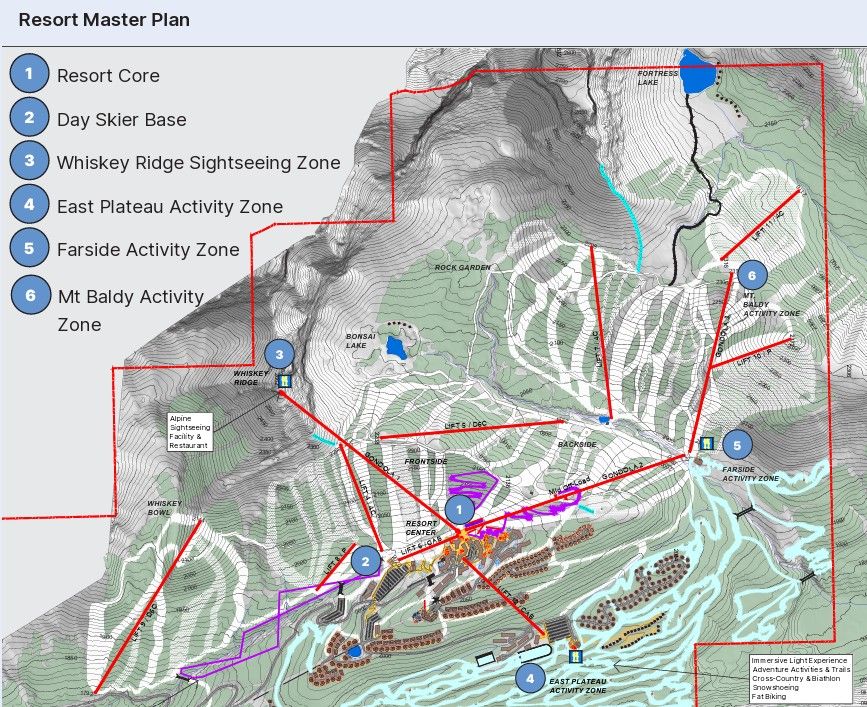
Alberta: Fortress Mountain Resort Master Development Plan Decision SummaryThis summary explains a decision about an application submitted for an all-season resort development in the Fortress All-Season Resort Area. Source: Government of Alberta The Decision After reviewing the application by Fortress Mountain Resort (FMR), the designated Director with the All-Season Resorts regulator under the All-Season Resorts Act (the regulator) approved the resort’s Master Development Plan (MDP) with conditions on June 5, 2026. The decision was made under the All-Season Resorts Act and the All-Season Resorts Regulation, the legislation that set out how proposed all-season resorts on provincial Crown land are reviewed. The regulator has legal authority at this stage to approve, approve with conditions, or refuse an MDP. This is a concept-stage decision as per the all-season resort regulatory framework. It confirms that the overall resort idea is complete, feasible, and aligns with applicable policy and land-use plans, provided that a set of conditions is satisfied before the project can advance. About the Proposal The Fortress site covers roughly 1,471 hectares of provincial Crown land in Kananaskis Country, surrounded by Spray Valley and Peter Lougheed Provincial Parks. It operated as a ski area until the early 2000s and is currently held under a long-term tourism and commercial lease. The current lease permits a range of recreational activities including but not limited to skiing, hiking, ice climbing/climbing walls, zip lines, canopy tours, mountain coasters, via ferrata, cross country skiing, and mountain biking. along with a day lodge and commercial activities. FMR proposes redeveloping the former ski area into a year-round mountain destination built around a base-area village, with gondolas and lifts serving both winter and summer activities. Winter use would include skiing and other snow activities; summer use would centre on lift-accessed sightseeing, mountain biking, hiking, and other attractions. The resort would be built in five phases over at least fifteen years, with each phase depending on the performance of the one before it. At full build-out it is planned to accommodate about 8,300 visitors per day, along with overnight accommodation, employee housing, and resort services. What This Decision Means It is important to understand the scope of this decision. Approving the MDP confirms that the resort concept is satisfactory to the Government of Alberta and can move to the next stage of review. It is not a final approval, and it does not allow construction to begin. What Approval Does • Confirms the resort concept is complete, feasible, and aligned with applicable policy and land-use plans. • Gives the proponent greater certainty that the project may proceed to the next stage. • Sets high level conditions that must be satisfied before the project can advance to the next stage of approval. A separate, later decision, the disposition decision, is required before any land rights are granted. That decision is made on its own merits and only after the conditions of the MDP approval are met and consultation with Indigenous communities is completed and found adequate. How the Proposal Was Assessed The MDP is the primary document in an all-season resort application. It describes the resort, the planned activities, services, amenities, how development would be phased over time, and how many visitors the site could accommodate. At this stage, the review focuses on whether the concept is appropriate for the landscape and feasible in principle. It does not consider detailed engineering or construction design details. The proposal was assessed against three criteria set out in the All-Season Resorts Regulation: • Completeness: whether the information contained in the MDP and associated application components was sufficient to understand and assess it. • Feasibility: whether the MDP demonstrates the resort can realistically be built and operated, whether the site is suitable, whether the proposed number of visitors is appropriate for the landscape, whether environmental impacts can be reasonably managed, and whether the proponent has the financial and organizational capacity to deliver it. • Policy alignment: whether the proposal aligns with the All-Season Resorts Act and policy, applicable regional and sub-regional land-use plans, and other government direction. All three criteria must be met, with or without conditions, for the plan to be approved. What Information Was Considered The decision was based on a broad review of the disposition application record by the regulator and input from technical experts, other government agencies and feedback from the public. This included: • The all-season resort application, including the MDP, environmental assessment, business plan, economic impact analysis, engagement and consultation plans, and emergency-services and wildfire assessments. • Additional information FMR provided in response to a formal request from the department for supplementary information, including independent technical work on water, servicing, and visitor capacity. • Technical reviews from provincial agencies responsible for fish and wildlife, parks, wildfire, public lands, transportation, municipal affairs, and fire safety, as well as Travel Alberta and the Kananaskis Improvement District. • Public feedback gathered by the Government of Alberta during a 30-day public notice period and through the proponent’s own engagement, summarized in a “What We Heard” report. • An assessment confirming the level of consultation required with affected Indigenous communities. Issues Considered During the Review Issues raised through the review process required close examination. The issues examined included alignment with the South Saskatchewan Regional Plan and other land use plans, environment and wildlife, public benefit and access, public and indigenous input, scale, visitor capacity and recreation, transportation and access, water and municipal services and wildfire and emergency management. Conditions of Approval The approval includes conditions in two broad groups: • Updates to be made now: FMR must revise the MDP to align all visitor-capacity figures with the independent technical analysis, incorporate design changes identified through the review (such as relocating the planned mountain-top restaurant to the base area), and remove references to motorized general recreation. FMR also must update to include the additional commitments made in response to the public notice. • Requirements before the next decision: Before a disposition decision can be considered, FMR must complete further work, including site-specific wildlife and fisheries surveys, a schedule for the development of a set of environmental management plans, an accepted environmental protection plan, detailed first-phase servicing plans, an emergency-services strategy with the local district, any required development agreements and completion of adequate Indigenous consultation. What Happens Next With the MDP approved at the concept stage, the project may now work toward the next stage, the disposition decision, which determines whether, and on what terms, the proponent is granted the legal right to use and develop the land. Before that decision can be made, the conditions of this approval must be satisfied, additional approvals under other legislation may be required, and consultation with Indigenous communities must be completed and found adequate. The disposition decision will be made separately and is not guaranteed by this approval. |
|

ropeways.net | Home | Slopes | 2026-06-19
 Back
Back Add Photos
 Print
PrintMore articles:
Cannon Mountain: Request for bids for an 80 passenger tramway
2026-06-26
Heavenly Mountain: Local art takes flight on the Heavenly Gondola!
2026-06-25
Powder Mountain: Bill Cubbage - Powder Mountains new General Manager of Resort Operations.
2026-06-25
Google Adsense